Job shadowing is a form of on-the-job training where one employee (the shadow) observes another employee (the demonstrator) while they are undertaking their work tasks (Tatum, n.d.). It is also known as work shadowing. 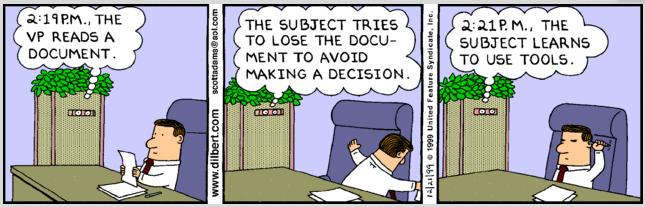 (Adams, 1999)
The terms ‘job shadowing’ and ‘work shadowing’ are often used to describe a form of work experience, however this is not the definition of job shadowing used in this wiki. Uses Job shadowing is commonly used as part of the induction process or when an employee is learning a new role. When used in this way the new employee shadows an experienced employee from one day to several months in order to gain an understanding of the requirements of the role (“Job Shadow – Wikipedia”, n.d.). Job shadowing can be used as a tool to assist in the transfer of tacit knowledge. Observational learning occurs when the shadow observes the demonstrator, stores the information and then copies the behavour. Through observational learning, information that is difficult to articulate can be transferred; for example negotiation skills (Nadlen, Thompson & Van Boven, 2003) or leadership skills (Kempster, 2009). Job shadowing can also be used to create an objective record of the tasks a role carries out and to analyse current work practices to facilitate continuous improvement (Digital Education Revolution NSW, 2009) Advantages  (Adams, 2009) Cost - There is no capital outlay required in order to use job shadowing. There are hidden costs in the loss of productivity for both the shadow and the demonstrator, however since shadowing is likely to be integrated with normal work practices the loss of productivity is likely to be less than external learning (Thomas & Qui, 2011). Efficiency - Job shadowing allows employees to see the tasks that they need to carry out in practice, so they are generally able to replicate these tasks more quickly than if they had learned in a classroom environment (Miller, n.d.). Good behavior modelling - Job shadowing can help employees learn the culture of an organisation by observing how other employees act in the work environment (Heathfield, n.d.). Communication - Job shadowing can help employees to build relationships with their colleagues (Tatum, n.d.) and other parts of the organisation (Manchester Metropolitan University, n.d.). Shadowing can help employees gain a broader understanding and appreciation of the variety of jobs that are carried out in the organisation (Manchester Metropolitan University, n.d.). Improved Self Efficacy - Job shadowing can have a positive impact on an employee’s confidence in undertaking the tasks that they have observed (McCarthy & McCarthy, 2006; Tatum, n.d.). Tacit Knowledge Transfer - Job shadowing can be used as a tool to assist in the transfer of tacit knowledge; which is often difficult for an organisation to retain (Levy, 2011). In this way job shadowing can be used for succession planning. Disadvantages  (Adams, 2004) Bad behavior modelling - To ensure that the training delivered is in keeping with the organisations values careful consideration should be given to which employees are engaged to be demonstrators (Vickers, 2009). Lack of structure - Job shadowing is often done in an informal manner. This means that there are no specific objectives, content or procedures. Also, the demonstrators are often chosen for their technical skills and might not have the required skills to facilitate learning (“On The Job Training”, n.d.). To ensure that the shadowing is as effective as possible a structure should be developed for the program. Hints for using this method effectively As with all training, job shadowing will be most effective when carefully planned and implemented (Digital Education Revolution NSW, 2009). Some issues to consider include:
This sample shadowing agreement form can be adapted to your organisations needs.
Other alternatives or variations Fly on the wall - This is where the shadow observes the demonstrator with little or no interaction. This type of job shadowing is what is commonly used for work experience (Manchester Metropolitan University, n.d.). Burst interactions - This is where the shadow observes the demonstrator during a specific activity, not necessarily in one continuous period. There are debriefs before and after each session (Manchester Metropolitan University, n.d.). This type of job shadowing is useful for learning a specific skill that is experience based (eg coaching skills). The risk with this method is that it can be disruptive to the work of both the demonstrator and the shadow. Reverse Shadowing - This is where there is a transition that allows the shadow to put what they have learned into practice. First, the shadow observes the demonstrator carry out the task. Then the demonstrator watches the shadow carry out the task and provides the shadow with feedback (Digital Education Revolution NSW, 2009). Useful links Department of Education, Training and Employment Queensland (2010). A brief case for work shadowing – A workforce capability strategy for vocational education and training (VET). http://www.vetpd.qld.gov.au/resources/pdf/tla/brief-case-work-shadowing.pdf Digital Education Revolution NSW (2009). A guide to shadowing. https://www.det.nsw.edu.au/proflearn/der/docs/shadow/shadobk.pdf Manchester Metropolitan Unviersity [n.d.]. Job Shadowing Guidelines. http://www.mmu.ac.uk/humanresources/policy/pdf/job-shadowing-guidelines.pdf NoWAL [n.d.]. Job Shadowing Guidelines. http://www.nowal.ac.uk/training_and_development.php?page_id=27 Bury Council (2009). Job Shadowing Guidelines and Protocol. http://www.bury.gov.uk/CHttpHandler.ashx?id=2725&p=0 References Adams, S. (2004). Retrieved from the Dilbert Website: http://dilbert.com/strips/comic/2004-02-07/ Adams, S. (2009). Retrieved from the Dilbert Website: http://dilbert.com/strips/comic/2009-05-01/ Adams, S. (1999). Retrieved from Dilbert Website: http://dilbert.com/strips/comic/1999-12-21/ Department of Education, Training and Employment Queensland (2010). A brief case for work shadowing – A workforce capability strategy for vocational education and training (VET). http://www.vetpd.qld.gov.au/resources/pdf/tla/brief-case-work-shadowing.pdf Digital Education Revolution (2009). A guide to shadowing. Retrieved from the Department of Education and Communities NSW Website: https://www.det.nsw.edu.au/proflearn/der/docs/shadow/shadobk.pdf Heathfield, S.M. [n.d]. Why do organizations need to provide job shadowing for on-the-job training? Retrieved from the About.com Website: http://humanresources.about.com/od/On-The-Job-Training/f/Why-Organizations-Need-To-Provide-Job-Shadowing.htm Job Shadow [n.d.]. Retrieved from Wikipedia Website: http://en.wikipedia.org/w/index.php?title=Job_shadow&oldid=566224007 Kempster, S. (2009). Observing the invisible. Examining the role of observational learning in the development of leadership practice. Journal of Management Development, 28(5), 439-456. Levy, M. (2011). Knowledge retention: minimizing organizational business loss. Journal of Knowledge Management, 15(4), 582-600. Manchester Metropolitan University [n.d.]. Job Shadowing Guidelines. Retrieved from Manchester Metropolitan University Website: http://www.mmu.ac.uk/humanresources/policy/pdf/job-shadowing-guidelines.pdf McCarthy, P. R. & McCarthy, H. M. (2006). When case studies are not enough: integrating experiential learning into business curricula. Journal of Education for Business, 81(4), 201-204. Miller, B. [n.d.]. What are the benefits of job shadowing? Retrieved from WiseGEEK Website: http://www.wisegeekedu.com/what-are-the-benefits-of-job-shadowing.htm#didyouknowout Nadler, J., Thompson, L. & Van Boven, L. (2003). Learning negotiation skills: four models of knowledge creation and transfer. Management Science, 49(4), 529-540. On the Job Training [n.d.]. Retrieved from the Naukrihub.com Website: http://traininganddevelopment.naukrihub.com/methods-of-training/on-the-job-training/ Tatum, M. [n.d.]. What is job shadowing? Retrieved from the WiseGEEK Website: http://www.wisegeek.com/what-is-job-shadowing.htm Thomas, H., & Qiu, T. (2012). Work-related continuing education and training: participation and effectiveness. Journal of Workplace Learning, 24(3), 157-176. Vickers, M. (2009). Trendwatcher: is job shadowing ignored in your organisation? Retrieved from the HRWorld Website: http://www.hrworld.com/features/trendwatcher-job-shadowing-ignored-092909/ |

